
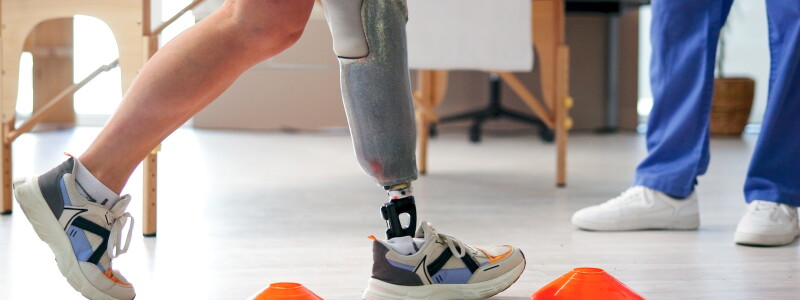
Every step a knee-replacement patient takes, every grip of a modern prosthetic hand and every heartbeat sustained by an implanted device traces back to a single discipline: biomechanics. Where biology meets the laws of motion, engineers find ways to restore mobility, ease pain and improve lives. Professionals in biomedical engineering rely on these principles to design artificial body parts, such as hip and knee joints, and create life-changing rehabilitative exercise equipment.1 As populations age and patient expectations climb, understanding how the body moves and responds to force matters more than ever.
This post explores the core concepts of biomechanics, its role in human movement and healthcare innovation, and how mechanical principles improve patient care.
Key Takeaways
- Biomechanics applies mechanical principles to understand and improve biological systems
- Engineers use these concepts to design supportive medical equipment and rehabilitation tools
- Understanding load distribution is critical for the longevity of joint replacements
- Clinical biomechanics translates mechanical research directly into diagnostic tools and patient care
Understanding Biomechanics in Biomedical Engineering
Biomechanics is defined as the study of the structure and function of biological systems by means of the methods of mechanics.2 In practice, it investigates the deformation and motion of living organisms to elucidate biological mechanisms and address complex scientific challenges in the health and life sciences.3
Applied to biomedical engineering, the discipline combines classical engineering methodology with the life sciences to solve medical problems.4 Biomechanics engineers specifically study thermodynamics and mechanical systems to formulate biological solutions.1 Case Western Reserve University embraces this foundational relationship through coursework that teaches students to apply basic principles of mechanics to understand, explain and model biological processes across cell, tissue and organ scales.5
The Role of Human Body Mechanics
Engineers study human body mechanics to understand movement, forces and structural integrity within living organisms. Researchers use tools such as motion analysis, electromyography (the recording of electrical activity produced by muscles) and gait analysis to evaluate how the body functions and reacts to various stressors.5 They also examine how the heart, vasculature and tissue scaffolds respond to mechanical loads.
This foundational knowledge drives innovation in medical devices, prosthetics and rehabilitation tools. With an estimated one in two U.S. adults living with a musculoskeletal condition, the demand for technologies that restore or improve movement lost to injury or disease is enormous.6 When engineers grasp the intricacies of musculoskeletal mechanics, they can design devices that integrate seamlessly with the body and address some of the most disabling and costly conditions in healthcare.7
The Importance of Biomechanics in Healthcare Innovation
Biomechanics shapes a striking range of modern medical breakthroughs, from cutting-edge wearables and orthotics to fully patient-specific implants. For example, the discipline informs the design of systems that replicate or support natural movement, while advanced sensors deliver real-time data for personalized rehabilitation.8 Engineers also use 3D printing and finite element models to craft prosthetic and orthotic devices that fit a patient's unique anatomy with remarkable precision.9
A working knowledge of musculoskeletal mechanics also helps prevent injuries and shorten patient recovery times. Biomechanical modeling and simulation aid in designing targeted injury prevention strategies and enhancing the effectiveness of overall rehabilitation programs.10
Advancements in Clinical Biomechanics
Clinical biomechanics translates mechanical research into direct patient care and diagnostic tools. The discipline strengthens the links between laboratory research and clinical practice, supporting healthcare providers in the diagnosis, prognosis and evaluation of treatment methods.11 Biomechanical models help researchers and clinicians understand disease mechanisms and predict treatment outcomes to optimize medical interventions.12
Engineers frequently collaborate with medical professionals to apply these principles toward improving surgical outcomes. For instance, the integration of biomechanics, biology and artificial intelligence in procedures such as anastomosis (the surgical joining of two tubular structures, such as blood vessels or sections of intestine) aims to improve clinical outcomes, reduce complications and promote functional healing.13 In effect, clinical biomechanics serves as the bridge between theoretical physics and real-world medical care.5
Real-World Applications: Load Distribution and Mechanical Systems
Engineers designing supportive medical equipment and joint replacements must manage load distribution carefully to protect patient comfort and ensure implant longevity. A common challenge in orthopedics is a mismatch in stiffness between the implant and natural bone, which can lead to stress shielding (a weakening of bone that occurs when an implant absorbs forces the bone would normally bear).14 Because common implant materials are much stiffer than human bone, the load is primarily transferred through the implant rather than the bone itself.15 This altered load distribution can cause bone resorption in underloaded regions. To counter this effect, engineers have developed additively manufactured porous metal scaffolds that promote a more uniform load distribution to the bone.14
These universal mechanical principles apply broadly across different engineering disciplines, operating much like the physics behind a weight distribution hitch used in vehicle towing. When a vehicle tows a heavy trailer, a weight distribution hitch uses spring bars placed under tension to transfer downward force away from the rear and redirect it into the front axle.16 The effect evens out overall suspension loading.17 Just as this towing system manages opposing forces to maintain vehicle balance and safety, biomechanical implants must carefully manage internal forces to restore balanced system performance and avoid overloading specific areas of the human body.
Build a Career That Moves Medicine Forward
Biomechanics continues to make fundamental changes in how clinicians treat injuries, how engineers design medical devices and how patients experience long-term care. A command of these mechanical principles can place you at the forefront of healthcare developments that improve lives every day. Case Western Reserve University’s online Master of Science (MS) in Biomedical Engineering program is designed to build your expertise in translating biomedical ideas into clinical implementation.
The project-focused curriculum requires 30 credit hours and provides the deep technical knowledge needed to advance your career in industry, academia, or healthcare. As a student, you will explore vital subjects ranging from clinical correlates to the next wave of bioinstrumentation. The Case School of Engineering is rooted in Ohio, but our online format lets you collaborate with expert faculty and a nationwide network of peers from anywhere.
Our team is available to help you understand the admissions process and explore your options for tuition and financial aid. If you have specific questions, you can always contact us directly. When you are ready to take the next step in your career, apply online or schedule a call with an admissions outreach advisor.
- Retrieved on May 19, 2026, from bls.gov/ooh/architecture-and-engineering/biomedical-engineers.htm
- Retrieved on May 19, 2026, from pmc.ncbi.nlm.nih.gov/articles/PMC1888377/
- Retrieved on May 19, 2026, from pmc.ncbi.nlm.nih.gov/articles/PMC13069430/
- Retrieved on May 19, 2026, from sciencedirect.com/topics/immunology-and-microbiology/biomechanics
- Retrieved on May 19, 2026, from bulletin.case.edu/course-descriptions/ebme/
- Retrieved on May 19, 2026, from ncbi.nlm.nih.gov/books/NBK559512/
- Retrieved on May 19, 2026, from pmc.ncbi.nlm.nih.gov/articles/PMC10788788/
- Retrieved on May 19, 2026, from pmc.ncbi.nlm.nih.gov/articles/PMC11537846/
- Retrieved on May 19, 2026, from pmc.ncbi.nlm.nih.gov/articles/PMC10860223/
- Retrieved on May 19, 2026, from pmc.ncbi.nlm.nih.gov/articles/PMC11351747/
- Retrieved on May 19, 2026, from sciencedirect.com/journal/clinical-biomechanics
- Retrieved on May 19, 2026, from journals.lww.com/jasc/fulltext/2024/05020/applicationofbiomechanicsinmedical_sciences.1.aspx
- Retrieved on May 19, 2026, from sciencedirect.com/science/article/abs/pii/S1571064525001514
- Retrieved on May 19, 2026, from frontiersin.org/journals/bioengineering-and-biotechnology/articles/10.3389/fbioe.2025.1562367/full
- Retrieved on May 19, 2026, from pmc.ncbi.nlm.nih.gov/articles/PMC9841707/
- Retrieved on May 19, 2026, from weigh-safe.com/towing-safety/complete-guide-to-towing-with-a-weight-distribution-hitch/
- Retrieved on May 19, 2026, from lippert.com/blog/what-is-a-weight-distribution-hitch